
Let’s set aside for the moment the enormous practical advantages that this form of learning support presents compared to more traditional forms; we will discuss these in detail later: here we try to account for a much more pressing evidence concerning the fact that the use of the microcycle is enormously more effective (and efficient) than using the so-called traditional methods.
I resist the temptation to illustrate the current state of the so-called “Sciences of Learning”; the literature on this topic is not vast but quite substantial. Although the evidence provided by various researchers deserves respect as the fruit of their best field observation work, test construction, and experiments, I think it is crucial to focus on the critical point common to all the theorizing formulated upstream and downstream of field research.
In other words, those “explanations” (those theoretical models) end up explaining nothing; they do not give us the answer we seek: they do not tell us why.
It is almost incredible, despite enormous investments of money, time, and energy, they do not even tell us how to safely accompany a human learning process; they cannot even provide a shred of a hypothesis on why (yes, the why of earlier) this or that “educational model” works or does not work.
We know, or at least some of us know, the ultimate limit of human knowledge: we do not know what energy is and consequently what matter is.
Our knowledge reaches up to that point to the undeniable evidence that something we call matter exists, that it is one of the possible transformations of energy, and that something we call energy exists. Period.
Beyond that limit, no human thought can go with certainty and scientific security; beyond that limit, we can go with magic or faith, not with science.
Science deals with what is in between, what goes from us to that distant point that is the beginning of energy (assuming it has a beginning; we do not know), of what comes from that distant point that is the beginning of energy and reaches each of us.
Good science connects point by point without leaving gaps, without skipping steps, allowing us to trace back step by step from any configuration of the environment (as we will see better later, real-real environment and virtual-real environment) we deal with to its ultimate root.
The terrible critical point common to all so-called learning theories fundamentally consists of three serious violations:
- The first is in the almost always tacit and undeclared adoption of models of the human mind, theories of the human mind that are undefined or extremely limited: from the legendary black box to the cybernetic mind.
- The second violation consists of implicitly or explicitly considering the evident absence of explicable connections between different theoretical formulations (their “explanations”) and other decidedly important pieces of each of our lives as non-relevant: even when the learning process is considered to occur in a context, the context becomes the limit beyond which we do not go.
- The third serious violation consists of ignoring, beyond words, the indissoluble connection between learning and survival in the specific and distinctive forms of survival of the subject of the species homo sapiens.
Only recently have attempts appeared by scholars who have adopted the fundamental elements of what can legitimately be called Systems Theory (many authors have contributed to this fertile theory, which, however, is far from being fully developed) generating a different and better observation, analysis, and understanding of human learning processes.
It is based on these systemic elements that we are better able to explain which “methods” of accompanying the learning process can work and which do not within the normal contexts in which humans live and act, not in research laboratories.
It is from the use of a systemic model of the human mind that it becomes possible, for example, to almost entirely eliminate the use of the group—the millennial form of the educational/training setting—from the teaching method of knowledge and skills related to kaizen: in this case, as in many others, the group is a process muda, no more, no less.
We did not arrive at this experimentally through trial and error without an explanation of why yes or why no: we arrived at it with a strong hypothesis (all knowledge is ultimately only more or less strong hypotheses) about the systemic configuration of the so-called human mind once faced with the seemingly naive or heretical question, “Is the group useful?”
We all know that the group, the class, has been and is massively adopted, that in any Kaizen program (or Lean or whatever they want to call them) a large part of the “work” is expected to be carried out in a group: for what reasons?
All the “explanations” that are ordinarily provided, as is easy to demonstrate, have nothing to do with the systematically observed learning process: the learning process is “closed” within each subject, governed and determined solely by each individual subject.
The work of elaborating and generating new neural software is carried out (or not carried out) by each individual subject assisted by an expert, a master: how can the group contribute to the particular task of acquiring Kaizen knowledge and skills?
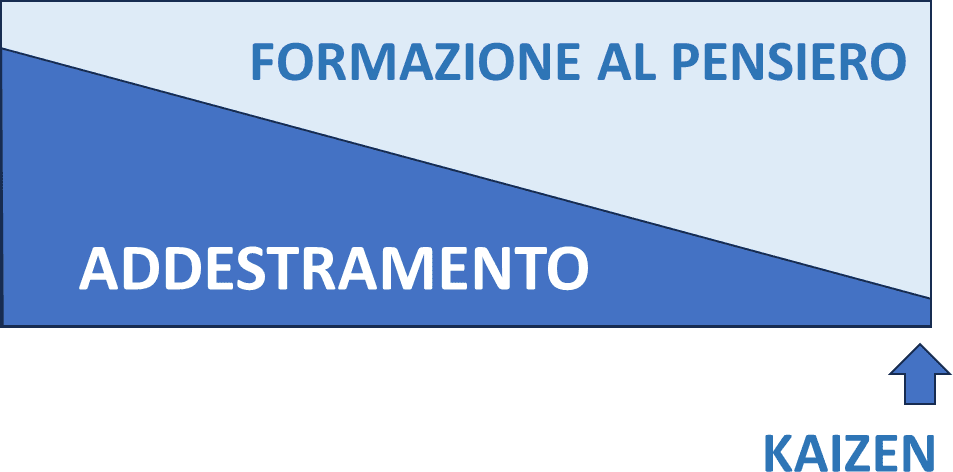
To a systemic observer, as to any expert in the field, it is entirely evident the particularity of this specific learning task compared to other learning tasks: the particularity described in common terms is constituted by the high rate of “training in thinking” and the concomitant low rate of “training.”
As systemics, we know that this condition has significant implications regarding the choice of method and tools to accompany the learning process, implications interpreted very differently from current non-systemic “theories of human learning”: one of these implications is the absolute preference for the 1-2-1 setting.
A second implication invisible to non-systemic observers concerns 1) the duration 2) the frequency and 3) the “calendar” of training sessions: if the focus is the learner’s learning curve and not the presumed and illusory “economies” of both the organization and the master, for us systemics, it is evident that little-and-often is far more favorable than much-every-now-and-then or much-and-concentrated.
Practically, it is to be avoided with all care except in specific and rare cases of the learning path, sessions longer than 20-30 minutes, acceptable also sessions of 10-15 minutes or even less (my personal record is 8 minutes, and I plan to improve it further).
“Often” here means 3-4 times a week, even 5 in the initial phase, each time seeking the best possible compromise between the learner’s agenda and the master’s: this also plays a significant role predominantly ignored by non-systemic human learning theories; agendas reflect life, they are not a calendar of occurrences.
Finally, the systemic accreditation process of the master.
Everyone has had experiences with teachers with whom and from whom it was relatively easy to “learn” (very few generally) and others with whom and from whom it was substantially impossible: the dismal lack of a convincing model of the mind by non-systemic scholars has relegated this key factor to the realm of “natural” idiosyncrasies, “character incompatibilities,” or neuroses (mostly attributed to learners) and other ramblings of that kind.
For us systemics and kaizenists, it is evident, thanks to the adoption of a less indecent and tattered model of the mind that we have wanted and been able to develop, that the articulations, the nodes, the hysteresis of the process of accompanying learning and the concomitant learning process have so far been only partially intuitively grasped, never captured in their nature nor even partially described: certainly, we cannot claim to have exhausted the task of new exploration and minimal re-understanding of this extremely complex field, but we can affirm to have written some chapters of a book that before us was substantially blank with too many scribbles and messes in the written part over thousands of years.
Today, we also found a new one: trust in the master hinders learning; it will be a funny little chapter.
For a while, this worried us: how dare we insignificant short-lived beings challenge what has been handed down for thousands and thousands of years by hundreds of thousands, if not millions, of other humans who have dedicated their lives to the study and exercise of the art of teaching?
Well… now we don’t worry about it anymore. This is Kaizen, what else?