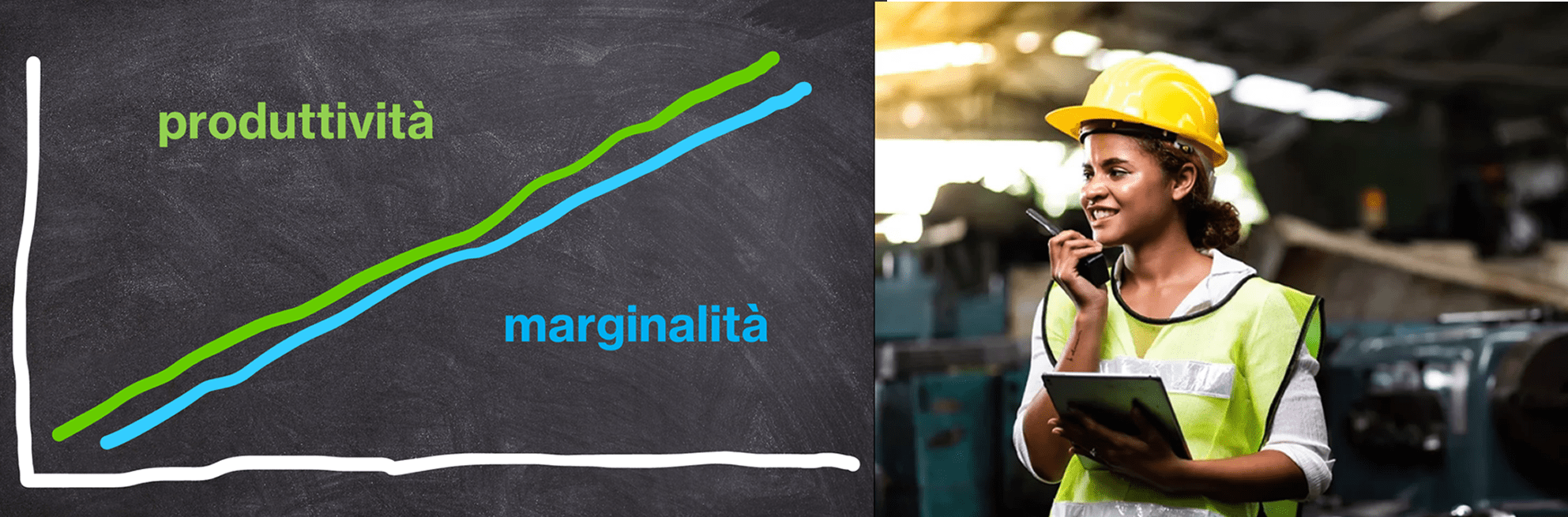


We need a bit of luck, well, it’s necessary every now and then, right? Our brilliant engineer, a tall, beautiful black woman, is about to present the results of the first token of 20 microLABs to the Management Team, 5 slides, let’s look at them together… first slide, two numbers, 24% and 105%.
24% is the measure of process improvement estimated before we started working together (data table in a separate file, to be distributed after the presentation).
105% is the measure of process improvement achieved during the 20 microLABs… data table in a separate file. Are we happy? Yes, indeed, very much… during the microLABs we’ve seen all sorts of things, it worked this time too.
The other slides summarize additional data: improvement in profitability, process lead time, a well-done presentation, rich and meaningful.
Even our brilliant engineer has absorbed, over the years, the entire Kaizen-lean repertoire, because with us it’s yes (105%) and before it was no (24%)?
It’s a medium-sized company by European standards, organizational complexity, markets, processes, certainly not easy, the intertwining and interdependencies are known: what really made the difference?
In the end, all this complexity and difficulty boils down to little: improvement (continuous, spot, whatever you want… wherever you want, at work, at home, in sports, in relationships…) can be achieved by increasing the value generated and reducing, eliminating, non-value. And this is the key. Simple, right?
Easy? Oh no, definitely not easy. You need to precisely identify the “Customer,” and it’s not so obvious everywhere: it’s easier at work, the Customer is the one out there (and only out there, don’t be fooled by internal customers, the issue is crucial, the Customer must always be outside, in the environment, not within the system in which one finds themselves) who pays for what they receive.
Value and non-value must be rigorously identified by observing and analyzing the processes from the Customer’s point of view: for example, transportation is non-value, transformation is value. Seven fundamental types of non-value, they are the old muda of Kaizen memory, they are more than sufficient, no need for more, and even for everyday work, it’s not taken for granted that we constantly keep them in mind, we all know the trap of the seventh dwarf.
And then two heads.
It takes two to succeed, exceptions are very rare, from one in a thousand to one in ten thousand, more or less that’s the order of magnitude.
We’ve called them supporter and protagonist, we are the protagonists, the supporter is the one who helps us, from start to finish: correctly identifying value and non-value, identifying and realizing what increases value and eliminates non-value, and then, once the new “productive” condition is reached, starting over and improving again, increasing value, eliminating non-value…
So, does the supporter need to be an expert? A wise person? Well, yes and no: at work, which is the area we’re interested in now, it’s not rocket science, you don’t need NASA scientists for this.
Certainly, they need to know the seven dwarfs (and we need to know them too), but that’s quick… and they need to be able to look, with us, at every step, from the Customer’s point of view, and correctly identify as soon as possible, with us, the value and non-value of each step.
Then they need to help us (not replace us, just help) in the observation and analysis phase, identifying the action that can increase value or eliminate non-value, then testing and trying, verifying and evaluating the result obtained, and transforming it into the new standard if the verification is positive.
And, if it’s not, starting over… eh? Oh yes, old stuff this too, PDCA, nothing else is needed, it is not rocket science, I had said.
In short, all old, known stuff: yet, facts and numbers say this doesn’t work, it’s not enough to generate, continuously, productivity and profitability improvements. True. Why?
Why, even using the correct key, does it not succeed? Apart from the usual Toyota, Komatsu, and Honda…
Not that the literature is vast, but it’s quite substantial, many have tried to answer, to propose new recipes, for forty plus years, everyone has hit, more or less quickly, their nose against the wall.
In one of the best contributions I know (Toyota Kata, Rother M. et al., 2010) interesting indications are found, pieces of attempts at answers, in the others, many, we find lots of how-to’s, the answers to why, not really. Isn’t it interesting?
Despite everyone knowing that no problem can be effectively solved without knowing the problem well, having understood it deeply, we keep finding solution proposals always (apparently, they are actually revamps, restyling, rephrasing, relabelling) new, and no new answer to: why?
Here, again, there is something new in what we propose: it doesn’t work because they (not us) continue to consider the problem in a non-systemic way.
And even when they try (yes, someone has tried, even recently, I have in mind a capable engineer, met when I served Schneider Electric, not a few years ago), it takes little to see that there is very little systemic in what they propose… better than nothing, but very little.
There is a call to look, consider, analyze the “system,” but usually nothing new on how.
Among the primary reasons for this insurmountable difficulty is an important gap, it may seem pure theory, or even metaphysics, but the fact is that at the base there is a poor, inconsistent, and contradictory model of the human mind.
And based on this model, mostly used without even thinking about it, as it is the most “common” and to which no one or almost no one objects and opposes, teaching-learning practices are devised and adopted that prove to be, irremediably, ineffective.
So do we come to explain to you which one is right, or at least better than before and tell you how to do it? Certainly not.
Saying, telling, helps little, often even harms.
It’s not a mystery, there is no mystery, a first draft of a systemic model of the human mind I published in 2016, it’s accessible to anyone, ISBN 9788892317758, since then I’ve made many advances, but the model has received few variations, it’s quite robust, it has held up well over the years.
Saying here what the “novelty” consists of takes little: like everyone else, even our brilliant engineer, to go from 24% to 105%, has modified some of her neural software (yes, we are biological machines, yes, we operate using neural software, yes, part of it is modifiable): could she have done it alone before? In theory, yes, statistics are always the same, from 1 in a thousand to 1 in ten thousand… incidentally, I am not among those.
To modify our most “critical” software, something only we can do and no one else, in the vast majority of cases we need the help of another, of a supporter, as we’ve called it to simplify and make ourselves understood, as much as possible.
Describing exactly what a good supporter does and doesn’t do is not impossible, it’s very long, here there’s no room: but even if there were, it would serve little, it would perhaps give a more detailed image, but necessarily incomplete and, substantially, hardly operational.
It’s exactly like the core of our method, identifying value and non-value, you learn by doing, you do by learning, without direct contact with the process, as frequently and continuously as possible, the risk of empty talk increases exponentially.
While we like and need the simple clarity of: before=24%, after=105%
No need to tell you how to do it so you learn, you need to do it.
And after you’ve done it, after you’ve gathered evidence of your success, then you’ll know how to do it.
The supporter, in the complex context of organized work, is also something else, does something else, besides enabling learning-change-improvement: we at Valinova are temporary supporters, usable to start continuous improvement that never stops, to enable your “supporters” and then exit the scene, as soon as possible… for today, that’s enough, I think.
Irresistible, just arrived, fresh: our brilliant engineer has presented her work, and she sends us a brief txt, [17:33, 22/07/2024] Done: colleagues very and sincerely interested, the DJ said we need to find a way to get young people working with this methodology… it went well.
Well, a little celebration is in order, even if small and short, it’s necessary, it’s hygiene and prophylaxis of good human behavior, otherwise, high costs are paid.
I wonder why the boss thought of advocating for the involvement of young people, obviously I don’t have the answer, I saw him briefly once, his schedule is said to be permanently headache-inducing, according to our magnificent engineer… but I have a strong hypothesis.
Young people have greater neuroplasticity than older ones, and so…
So, nothing. Age shows a weak correlation with the success of our work, the chances of success are the same for all age groups, this is the result of years of work and hundreds of people “served,” the decisive factors are really others. Which ones?
Well, come on, another time, now let’s celebrate.